Posts

Showing posts with the label Chapter 2

Featured Post

List of Questions and link to solutions

Chapter 1: Vector Analysis Problem 1.1: Using the definitions in Eqs. 1.1 and 1.4, and appropriate diagrams, show that the dot product and cross product are distributive, a) when the three vectors are co-planar. b) in the general case.  Solution   Problem 1.2 Is the cross product associative? $$(\vec{A}\times \vec{B}) \times \vec{C} \overset{?}{=} \vec{A}\times (\vec{B} \times \vec{C})$$ If so, prove it; if not, provide a counterexample (the simpler the better). Solution   Problem 1.3 Find the angle between the body diagonals of a cube.  Solution Problem 1.4 Use the cross product to find the components of the unit vector $\hat{n}$ perpendicular to the shaded plane in Fig. 1.11. Solution   Problem 1.5 Prove the BAC-CAB rule by writing out both sides in component form. Solution Problem 1.6 Prove that $$[\vec{A}\times (\vec{B}\times \vec{C})]+[\vec{B}\times (\vec{C}\times \vec{A})]+[\vec{C}\times (\vec{A}\times \vec{B})] = 0$$ Under what conditions does $\vec{A}...

Chapter 2 Electrostatics: Problem 2.38

Image
Problem 2.38: A metal sphere of radius $R$, carrying charge $q$, is surrounded by a thick concentric metal shell (inner radius $a$, outer radius $b$, as in Fig. 2.48). The shell carries no net charge. (a) Find the surface charge density $\sigma$ at $R$, at $a$, and at $b$. (b) Find the potential at the center, using infinity as the reference point. (c) Now the outer surface is touched to a grounding wire, which drains off charge and lowers its potential to zero (same as at infinity). How do your answers to (a) and (b) change?                       Solution: Create a spherical guassian surface with radius $r$ such that $a\le r\le b$.                       Since electric field inside a conductor is zero.  Hence the inner part of the shell with inner radius a will get induced with a charge $-q$. Now a make the shell electrically neutral, positive charge $+q$ will get induc...

Chapter 2 Electrostatics: Problem 2.14

Image
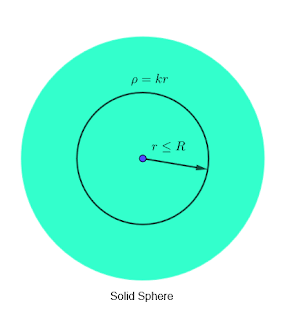
Problem 2.14 Find the electric field inside a sphere that carries a charge density proportional to the distance from the origin, $ρ = kr$, for some constant $k$. [Hint: This charge density is not uniform, and you must integrate to get the enclosed charge.] Solution: Given, $\rho = kr$  Consider a spherical Gaussian surface of radius $r_0$ such that $r_0\le R$ where $R$ is the radius of the sphere.                        By Gauss Law, $$\oint \vec{E}\cdot \vec{da} = \frac{Q_{enc}}{\epsilon_0}$$ Since the charge distribution is radially symmetrical, the direction of the electric field will be radially outwards. $$\therefore E\times 4\pi {r_0}^2 = \frac{Q_{enc}}{\epsilon_0}$$ $$Q_{enc} = \int_{vol.}\rho \times d\tau$$ $$Q_{enc} = \int_{vol.}kr \times r^2 sin\theta dr d\theta d\phi$$ $$Q_{enc} = k\int_0^{r_0} r^3 dr \int_0^{\pi} sin\theta d\theta \int_0^{2\pi}d\phi$$ $$Q_{enc} = k\times \frac{r^4}{4} \times 2 \times 2\pi$...

Chapter 2 Electrostatics: Problem 2.13

Image
Problem 2.13: Find the electric field a distance s from an infinitely long straight wire that carries a uniform line charge $\lambda$. Compare Eq. 2.9. Solution:                     Consider a Gaussian cylindrical surface of radius $s$ and length $h$.  Let the wire passes through the axis of the cylinder.  By Guass Law,  $$\oint \vec{E}\cdot \vec{da} = \frac{Q_{enc}}{\epsilon_0}$$  $\because $ Electric field through the plane surfaces of the cylinder is zero.  Also Electric field is directed outward and normal to the curved surface. $$\therefore E\times 2\pi s h= \frac{\lambda\times h}{\epsilon_0}$$  $$\therefore E= \frac{1}{2\pi \epsilon_0}\frac{\lambda}{s}$$   $$\therefore \vec{E}= \frac{1}{4\pi \epsilon_0}\frac{2\lambda}{s}\hat{s}$$      If you have any doubt regarding the solution or you want solution of some problem which is not posted please let me know by commenting. This encou...

Chapter 2 Electrostatics: Problem 2.12

Image
Problem 2.12 Use Gauss’s law to find the electric field inside a uniformly charged solid sphere (charge density $\rho$). Compare your answer to Prob. 2.8. Solution:                     Consider a gaussian spherical surface of radius $r$ where $r\ge R$  According to Gauss Law, $$\oint \vec{E}\cdot \vec{da} = \frac{Q_{enc}}{\epsilon_{0}} = \frac{\rho\times \frac{4}{3}\pi R^3}{\epsilon_0}$$  Since the charge distribution is symmetrical, $\vec{E}$ and $\vec{da}$ point in the same direction $\hat{r}$  $$E\times 4\pi r^2 = \frac{\rho\times \frac{4}{3}\pi R^3}{\epsilon_0}$$  $$\vec{E} = \frac{\rho\times R^3}{ 3 \epsilon_0 r^2}\hat{r}$$  Now, For $r< R, Q_{enc} = \rho \times \frac{4}{3}\pi r^3$  $$E\times 4\pi r^2 = \frac{\rho \times \frac{4}{3}\pi r^3}{\epsilon_0}$$  $$E = \frac{\rho \times r}{3\epsilon_0}\hat{r}$$ Hence, For $r< R, \vec{E}=\frac{\rho \times r}{3\epsilon_0}\hat{r}$  For $r\ge R, \...

Chapter 2 Electrostatics: Problem 2.11

Image
Problem 2.11: Use Gauss’s law to find the electric field inside and outside a spherical shell of radius R that carries a uniform surface charge density σ. Compare your answer to Prob. 2.7. Solution:                      Consider a gaussian spherical surface of radius $r$ where $r\ge R$. According to Gauss Law,  $$\oint \vec{E}\cdot \vec{da} = \frac{Q_{enc}}{\epsilon_{0}} = \frac{\sigma\times 4\pi R^2}{\epsilon_0}$$  Since the charge distribution is symmetrical, $\vec{E}$ and $\vec{da}$ point in the same direction and the direction is $\hat{r}$  $$E\times 4\pi r^2 = {\sigma\times 4\pi R^2 \over \epsilon_0}$$  $$\vec{E} = {\sigma\times R^2 \over \epsilon_0\times r^2}\hat{r}$$  Now, For $r<R, Q_{enc} = 0$ $$\therefore \oint \vec{E}\cdot \vec{da} = \frac{Q_{enc}}{\epsilon_{0}} = 0$$ Since, $\vec{da}\ne 0$ and both $\vec{E}$ and $\vec{da}$ points in the same direction. $$\therefore \vec{E} = 0$$ Hence , For $r...

Chapter 1 Vector Analysis: Problem 2.10

Image
Problem 2.10: A charge $q$ sits at the back corner of a cube, as shown in Fig. 2.17. What is the flux of E through the shaded side?                   Solution:  Surround the charge by 8 such cubes such that 4 cubes are above and 4 cubes are below and all are geometrically equivalent.                   Consider, the bigger cube having all the 8 small cubes. By guass law, the total flux would be $$\oint \vec{E}\cdot \vec{da} = {Q_{enc}\over \epsilon} = {q\over \epsilon}$$  Let $\phi$ be the flux through the required surface (The dark one in the diagram).  There would be $4\times 6 $ such faces and all are geometrically equivalent. Hence, the flux through them would be same and summation of them would be the total flux. Hence,  $$\oint \vec{E}\cdot \vec{da} = {24 \phi} = {q\over \epsilon_0}$$  $$\therefore \phi = {q\over 24\epsilon_0}$$   If you have any doubt r...